The Real Outer Banks vs. the One on TV
The real Outer Banks isn’t one town – it’s a chain of barrier islands on one road. What the show gets wrong, and why October beats July.
The short version
A popular Netflix series shares its name with this place, but it was filmed largely elsewhere — mostly around Charleston, South Carolina. The real Outer Banks is not one town and not a hideaway: it is a long, thin chain of North Carolina barrier islands strung along a single road, with wild horses at one end and a shipwreck coast at the other. Hi, I'm Elissa. My husband Al and I manage homes here, and the honest truth is that the version most people picture is the one you get in October, not July.
Is the Outer Banks show filmed in the Outer Banks?
Short answer: no, not for the most part. The series takes its name from this stretch of North Carolina coast, but production has been based largely around Charleston, South Carolina rather than on the actual banks.
Netflix's own location guide lays this out plainly, and it is the single most common thing guests ask us about before they arrive. So let's get it out of the way and move on, because that is genuinely all we have to say about the show. This post is about the place.
And here is the part that surprises people: the real thing is stranger and better than a set. You cannot build a hundred-foot dune out of nothing. You cannot cast a herd of horses that have been on this sand since the 1500s. The real Outer Banks has those, and it did not have to invent them.
One housekeeping note. We have no affiliation with the series, we are not endorsed by it, and nothing on this page is a recap. If you came here for episode talk, we will be no use to you. If you came here wondering whether the coastline is worth the drive — keep reading.
What does the real Outer Banks actually look like on a map?
This is the thing people get most wrong. The Outer Banks is not a town you drive to. It is a chain of narrow barrier islands, in places only a few hundred yards wide, with the Atlantic on one side and shallow sounds on the other. Picking a town matters more here than in almost any beach destination we know.
Driving from Corolla at the northern end down to Hatteras village takes a couple of hours in good conditions, and considerably longer when summer changeover traffic is on the road. Guests routinely book a house in one town and then discover the restaurant, the brewery, or the lighthouse they had bookmarked is sixty miles south of them. Decide on your town first, then your house.
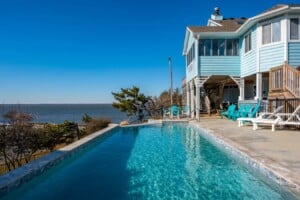
The second thing to understand is that every island has two completely different coastlines. The ocean side is surf, dunes, and sunrise. The sound side is flat, shallow, warm water, kayaks and paddleboards, and the sunsets — the sun goes down over the sound, not the ocean. Families with small children often prefer the sound; surfers and sunrise walkers want the ocean. Plenty of our guests want both and split the difference.
What is genuinely dramatic about the real Outer Banks?
Everything below is real, free or cheap to see, and run by people who will tell you the truth about conditions. We have linked each one to its own official site rather than quoting hours or prices, because those change and we would rather you got them from the source.
The honest version, since you will find out anyway. The Outer Banks is not a secret and it is not lawless. In July it is a traffic jam with a beach attached — a single lane each way through the villages, grocery stores stripped on Saturday changeover, and an hour to go ten miles. NC-12 is one road, and when storm overwash or construction closes it, it closes; there is no detour, only the ferry or waiting. If you arrive in peak summer expecting an empty wild coastline, you will be disappointed. Come in October and you will find something much closer to it. Check NCDOT's DriveNC before you set out, every time.
When does the Outer Banks actually look like the postcard?
Summer is the crowded version. Autumn and winter are the moody, wide-open, slightly cinematic version — which, ironically, is the one most people had in their head before they got here.
September and October are our honest favourites. The ocean is still warm from a whole summer of sun, the crowds thin out dramatically after Labor Day, rates soften, and you can park at the lighthouse without circling. The light goes long and gold in the late afternoon. It is the single best-value window on this coast and we say so to anyone who asks.
Winter is a different proposition and not for everyone. Plenty of restaurants close, the wind is serious, and swimming is off the table. But a soundfront house with a fireplace and nobody on the beach for a mile in either direction is a genuine experience, and it is when the Graveyard of the Atlantic coast feels most like its name. If you want the dramatic empty shoreline, that is when it exists.
Which Outer Banks house fits the trip you are picturing?
We manage a small number of homes here, mostly in Corolla and Duck. Pick the town first — then the house. Booking with us directly saves about 10% against a like-for-like flexible, refundable platform booking, with no platform service fee on our side.
On booking direct. It is not free money and we will not pretend otherwise — there is still a card processing fee of roughly 4.6%. What you avoid is the platform service fee, which is the larger number, and that is where the roughly 10% comes from. Our direct cancellation policy refunds 96% up to 14 days before arrival and 46% up to 7 days before, and you will see it at checkout before you pay anything.
So should you actually come?
Questions we get about the real Outer Banks
Is the Outer Banks show filmed in the Outer Banks?
Largely no. The series is named for this region but has been filmed mostly around Charleston, South Carolina, according to Netflix's own filming location guide. You can visit the real Outer Banks in North Carolina, but you will not be visiting the places you saw on screen.
Is the real Outer Banks one town?
No. It is a long chain of narrow barrier islands running down the North Carolina coast, linked by a single road, NC-12. Corolla at the north end and Hatteras village at the south are more than two hours apart by car, so choosing your town matters a great deal.
Are the wild horses real, and can you see them?
Yes. Colonial Spanish mustangs roam free on the four-wheel-drive beaches north of Corolla and are protected by the Corolla Wild Horse Fund. They are genuinely wild animals, so keep well back and follow the fund's guidance before you go looking for them.
When is the best time to visit the real Outer Banks?
September and October, in our view. The ocean is still warm, the crowds drop sharply after Labor Day, rates soften, and the light is at its best. Winter is quieter still and genuinely dramatic, but many restaurants close and the wind is serious.
What happens when NC-12 closes?
There is usually no detour. NC-12 is the only road down the banks, so storm overwash, flooding or construction can cut access to Hatteras entirely until it reopens or the ferries take over. Always check NCDOT's DriveNC road reports before travelling.
How much do you save booking an Outer Banks rental direct?
About 10% compared with a like-for-like flexible, refundable booking on a platform, because there is no platform service fee. A card processing fee of around 4.6% still applies, and our cancellation terms are shown at checkout before you pay.
Come see the place the show was named after
Wild horses, a brick lighthouse you can climb, a dune you can walk up, and a coast that has been swallowing ships for four hundred years. Pick an October week and we will help you pick the right town.
We are not affiliated with, endorsed by, or connected to any television series. Because there's no place you'd rather be.